

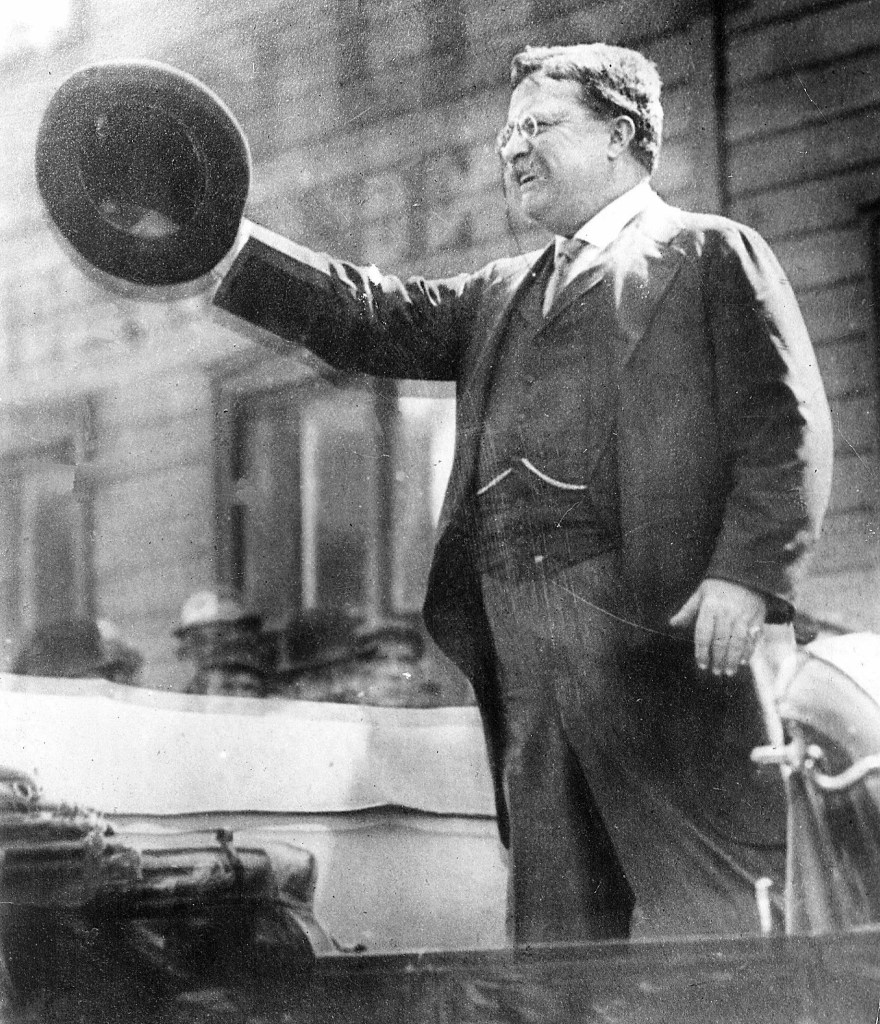
Let’s go back 112 years to another presidential election, this one a three-way race: William Howard Taft for the Republican Party, Woodrow Wilson for the Democratic Party, and former president Theodore Roosevelt for the Progressive Party (also called the Bull Moose Party). Teddy Roosevelt almost didn’t make it to election day. In Milwaukee he nearly met his end.
On September 14, 1912, John F. Schrank, a Bavarian tavern owner, wrote the following poem. He titled it “Be A Man”:
        Be a man from early to late;
	When you rise in the morning
	Till you go to bed
	Be a man.

	Is your country in danger
	And you are called to defend
	Where the battle is hottest
	And death be the end?
	Face it and be a man.

	When you fail in business
	And your honor is at stake
	When you bury all your dearest
	And your heart would break
	Face it and be a man.

	But when night draws near
	And you hear a knock
	And a voice should whisper
	Your Time is up; refuse to answer
	As long as you can
	Then face it and be a man.
John Flammang Schrank was born in Erding, Bavaria, twenty miles northeast of Munich, on March 5, 1876. Schrank’s father died of tuberculosis when John was two years old. John’s mother remarried and left him in the care of an aunt and uncle, Anna and Dominick Flammang. When John was thirteen, the Flammangs emigrated to America, taking him along with them. They arrived in New York on October 22, 1889, and soon after that Flammang bought a saloon to manage in an extremely poor section of the city. The aunt, uncle and their nephew all lived in a cramped apartment above the saloon. John attended night school where he learned to speak English fluently, and in time he became a naturalized United States citizen. When John was fifteen his uncle gave him a job tending the bar and delivering pails of beer to near-by tenements. In 1895 New York got a new president of the Board of Police Commissioners. His name was Theodore Roosevelt, and he sought to reform the liquor law so that saloonkeepers everywhere would have a difficult time getting around it. During Roosevelt’s two years as police commissioner Flammang’s saloon, as well as some others, were closed for two months with a policeman posted at the door. This caused the Flammangs to lose a great deal of money, and Schrank harbored a deep resentment toward Roosevelt during that time period (Schrank would later say this had nothing to do with his assassination attempt).
Schrank was a quiet man, never got into any trouble, and always made a good impression on strangers. Like Leon Czolgosz (the assassin of President William McKinley), Schrank had no personal relationships other than his aunt and uncle, and he never married. Having taken over the saloon business from his uncle in 1904, Schrank decided to sell it two years later. He continued to live with his aunt and uncle in their apartment, until their deaths in 1910 and 1911. The apartment was left to Schrank, but he sold it and moved out because he didn’t like his neighbors. He then rented a room in a small hotel called the Old Homestead, and soon he started to wander around the streets of Manhattan and Brooklyn in daydreams, reading voluminously and writing down whatever popped into his head.
During the 1912 presidential election, the New York Herald and the New York World were strongly opposed to Theodore Roosevelt’s third-term candidacy. Schrank, who read both of these newspapers avidly, was surprised that the Herald never called Roosevelt by name, but instead referred to him only as “the Bull Moose,” “the third-termer,” or “the third-term candidate.” During the campaign, Schrank also liked to use these expressions when speaking of Roosevelt. He now enjoyed dropping in at political meetings. Influenced by what he was reading and hearing, Schrank came to believe that the two-term limitation on the presidency was the most sacred thing in America. He held that “anybody who finances a third-term movement should be expatriated and his wealth confiscated.” Schrank also wrote: “Let every third termer be regarded as a traitor to the American cause. Let it be the right and duty of every citizen to forcibly remove a third termer.”
Back when Schrank was still living with his aunt and uncle over the saloon, something happened that later convinced him he was correct in his views of the two-term limitation. Schrank was asleep in the apartment early on the morning of September 15, 1901 — exactly twenty-three hours and fifteen minutes after President McKinley’s death — when he experienced a strange dream. In the dream Schrank found himself in a dimly lit room. He saw the figure of McKinley lying down in a coffin surrounded by flowers. Suddenly, the President sat up in his coffin and pointed an accusing finger toward a corner of the room. Schrank turned and saw Theodore Roosevelt dressed in a monk’s habit. “This is my murderer,” McKinley told Schrank. “Avenge my death.” Schrank knew, of course, that Leon Czolgosz had assassinated William McKinley. He had no idea what to make of the dream until shortly after Roosevelt was nominated by the Progressive Party in the summer of 1912. At half-past one on the morning of September 14 — one day before the eleven-year anniversary of William McKinley’s death — Schrank was again visited by the apparition of the deceased President. Schrank was sitting alone in his hotel room, writing “Be A Man,” when he heard someone say in a low, sad voice, “Let not a murderer take the Presidential chair. Avenge my death.” Schrank felt a hand lightly touch his shoulder, and he looked up into the chalk-white face of the late President William McKinley.
After being visited by McKinley for a second time, Schrank became convinced that Theodore Roosevelt had to be killed. He fully committed to the assassination, writing, “I am willing to die for my country. God has called me to be his instrument, so help me God.” Just like Charles Guiteau (the assassin of President James Garfield in 1881), John Schrank believed that God had assigned him the task of killing a political figure.
On Saturday, September 21, Schrank went to a gun shop on Broadway and bought a .38 caliber Colt for fourteen dollars and a box of Smith & Wesson cartridges for fifty-five cents. He cut a hole in the lower left-hand pocket of his vest, and he thrust the barrel of the gun down through it and under his trousers, with the handle conveniently in the pocket. Schrank then planned to catch up with Theodore Roosevelt somewhere on his campaign trip, which went across the United States and back. He embarked on ship after ship, train after train, but always he missed Roosevelt by a slight margin of time. In twenty-four days of travel covering more than two thousand miles and touching eight states, Schrank managed to be in the same city at the same time as Roosevelt in only three instances — Chattanooga, Chicago, and Milwaukee. The former two cities didn’t appeal to Schrank as ideal places to assassinate Roosevelt, but Milwaukee seemed to be just right.
On the afternoon of October 14, 1912, Schrank learned that Roosevelt would soon be leaving from the Gilpatrick Hotel by train. The assassin turned up at the Gilpatrick one hour before Roosevelt’s train was scheduled to arrive. A crowd had gathered outside the entrance to the hotel, just as the candidate’s open car pulled up to take Roosevelt away. Schrank blended into the crowd, arousing not the slightest suspicion. Roosevelt emerged from the hotel and crossed the sidewalk to his car. He got in and stood up to wave to his supporters. Just as he did so, Schrank poked his revolver between the heads of two men in front of him and pulled the trigger, not really aiming at any particular part of Roosevelt’s body. The former and possibly future president staggered backward, propping himself up with his hand against the rear seat. Although there was a flash of heat in his chest, the intense pain did not come as it was supposed to. The bullet had struck him in the right breast an inch below and slightly to the right of the nipple and bored inward and upward four inches, fracturing the fourth rib. Schrank had fired the shot from a distance of approximately six feet, and there is little doubt that the bullet would have killed Roosevelt if it had not had to first pass through the breast pocket of his coat, which heavily armored with the folded fifty page manuscript of his speech and his metal spectacle case. Thus the bullet lost much of its force before penetrating the flesh.
After Schrank was apprehended and dragged away, Roosevelt, ignoring the advice of his aides, insisted on making his scheduled speech. “It takes more than that to kill a Bull Moose,” he told frenzied supporters. Roosevelt spoke for fifty minutes, the bullet still lodged in his chest, before he began to feel a bit faint and finally agreed to seek medical attention. The doctors at the hospital saw no need to remove the bullet, and Theodore Roosevelt made a rapid and altogether splendid recovery. He carried the piece of metal in his chest until his death in 1919.
When the election was over and Woodrow Wilson had won, John Schrank expressed gratification that the two-term tradition had been upheld and apologized to the police for causing so much trouble. At his trial, Schrank was found not guilty by reason of insanity and sentenced to a mental hospital, where he remained for the rest of his life. In the thirty-one years Schrank spent in the psychiatric ward he never had a single visitor and never received a letter. When Theodore Roosevelt died, Schrank said, “I am sorry to learn of his death. He was a great American. His loss will be a great one for the country.” Schrank’s health began to fail in 1940, and he died of arteriosclerosis and bronchial pneumonia at the age of sixty-seven on September 15, 1943, forty-two years to the day after his dream in which President McKinley sat up in his coffin.
Eine feste Berg ist unser Gott.
[A mighty fortress is our God.]
 David Ewald: Author and Educator. This site and its contents © 2023 - 2026 David Ewald