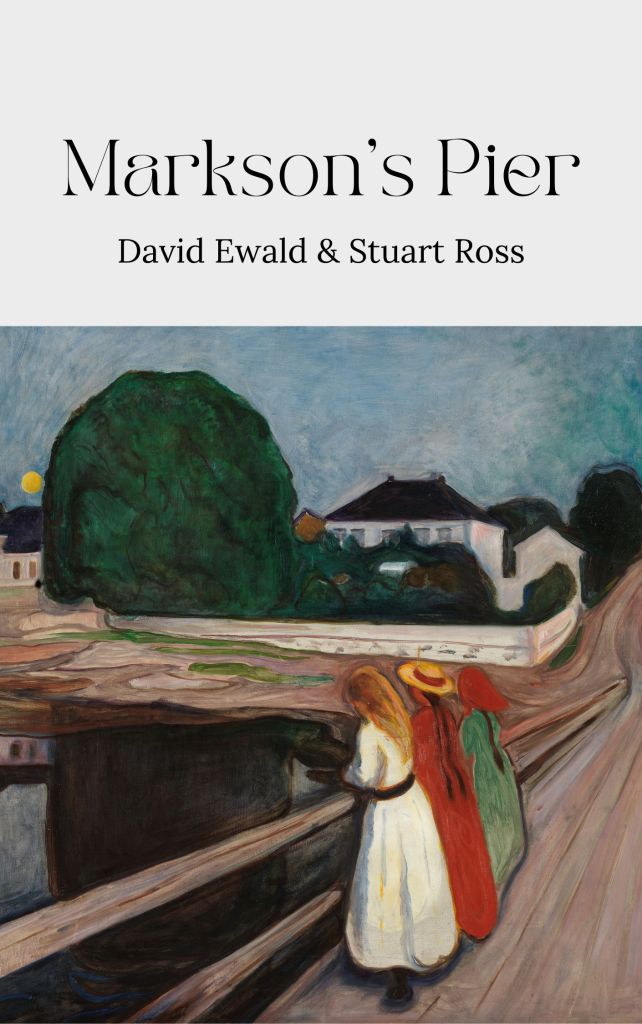

A writer circles an airport. His mind circles everything else.
An Embraer E-190 drops to 10,000 feet and enters a holding pattern. Inside, Writer turns over a restless inventory of writers and painters, composers and plagiarists, plane crashes and vanished books, borrowed lines and private memories.
Built from brief, accumulating fragments, Markson’s Pier is a darkly comic meditation on influence, mortality, and the afterlife of art. In sly conversation with the work of David Markson, David Ewald and Stuart Ross ask what writers take from the dead, what the living leave behind, and whether any work can ever be entirely its own.
A novel about circling, stealing, remembering, and the stubborn hope of arrival.
For more than a decade, Markson’s Pier was the most influential American novel you could not buy.
It circulated from writer to writer as a password-protected Word document, a badly compressed PDF, a printout missing its final pages. It was read in MFA apartments, church basements, fringe workshops, private Discord servers, and at least one writing group that dissolved following an argument over whether the book was actually a novel.
Gordon Lish was reportedly found hiding in his office with a copy, though he maintained that he was not reading it—only removing forty percent. The HTMLGIANT crew then spent twelve posts arguing that the missing forty percent was the actual novel.
Before Substack taught writers to transform stray quotations, private obsessions, browser tabs, cultural trivia, and aggressively specific facts into a literary platform, Markson’s Pier had already done it. Its influence can now be detected in newsletter modernism, citation fiction, doomscroll collage, the autobiographical reading list, and virtually every essay that begins with a confession and ends with a subscription link.
At its center is Writer: circling an airport in an Embraer E-190 while the whole of culture breaks into fragments around him. Painters and plagiarists. Suicides and plane crashes. Vanished books, remembered jokes, borrowed lines, and the fluctuating resale price of literary fiction.
Passed hand to hand, emulated without acknowledgment, and blamed for several tendencies in contemporary writing that almost certainly would have occurred anyway, Markson’s Pier has finally achieved print-on-demand.
The lost landmark of the post-blog generation has landed.
Markson’s Pier was originally published in Volume XI of Essays & Fictions, Winter/Spring 2013.